 Dra. Cléo Salustiano
 In this article
SummaryWhat is an implant-supported prosthesis and what are the types?When is it recommended and how do you care for it?FAQRead nextImplant-supported prosthesis: what is it and when is it recommended?
Book your dental implants assessment on WhatsAppPrefer not to wait for a reply? Book online now, no phone call needed: see the open times and pick yours, any time (booking page in Portuguese).
Quick summary of this article+
An implant-supported prosthesis replaces teeth by resting on implants, not on the gums or neighboring teeth. It can be a crown on one implant (one tooth), a fixed prosthesis on several implants (several teeth) or a removable one that snaps onto implants (overdenture), which stabilizes a denture. The recommendation depends on an assessment with imaging, and care involves specific hygiene and regular checkups. In Mooca, Dr. Cléo Salustiano (CRO-SP 170844) sees patients every day, 8 a.m. to 10 p.m.
An implant-supported prosthesis replaces one or more teeth by resting on implants instead of on the gums or neighboring teeth. It combines the stability of an implant with the function and appearance of a prosthesis. It's widely used when several teeth are missing or to stabilize a denture. Understanding the types helps you know when it's recommended.
In clinical practice, people often confuse an 'implant' with an 'implant-supported prosthesis.' The implant is the artificial root (the post in the bone); the prosthesis is the part that goes on top, which can replace one tooth or many, fixed or removable.
Here, Dr. Cléo Salustiano (CRO-SP 170844) explains what an implant-supported prosthesis is, the types, when it's usually recommended and how to care for it. As always, the recommendation is individual and made during an assessment with imaging.
This article comes from Dr. Cléo Salustiano's dental office in Mooca, São Paulo (care in English, Portuguese and Spanish). See the dental implants page to learn how the treatment is done here and book your assessment.
What is an implant-supported prosthesis and what are the types?
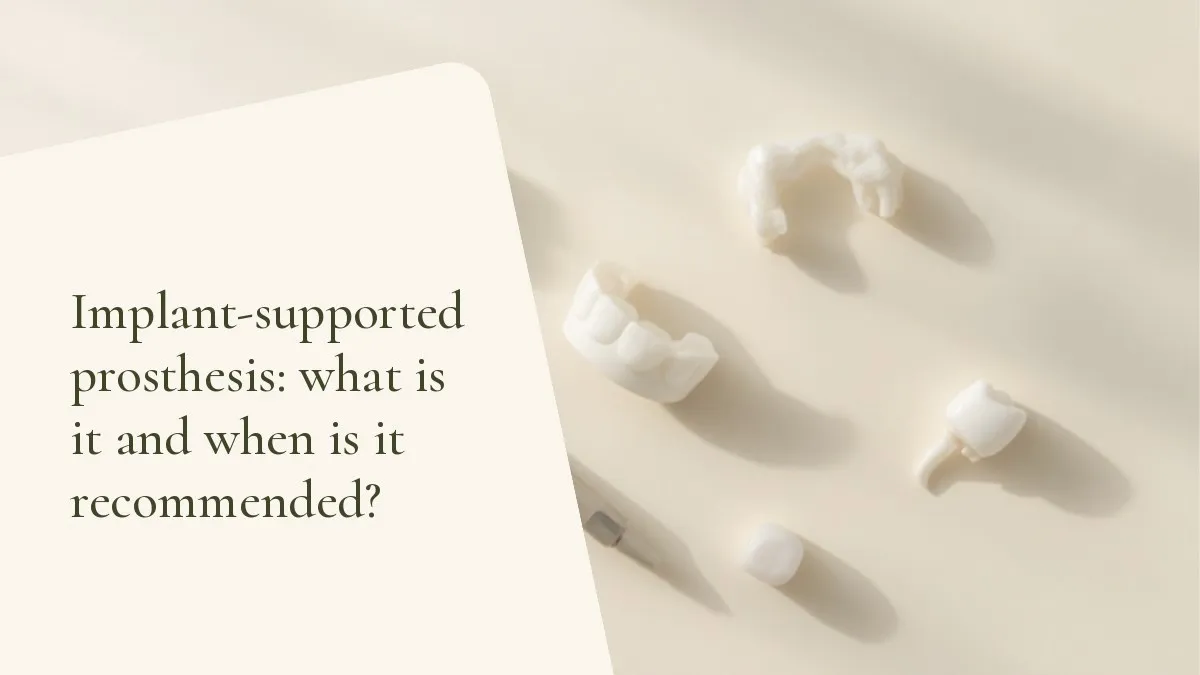
An implant-supported prosthesis is the structure (the visible, tooth-like part) that rests on one or more implants placed in the bone. Unlike traditional dentures, it doesn't rely on the gums to stay in place or on neighboring teeth for support. The support comes from the implants.
To replace a single tooth, an implant crown is used: the post replaces the root, and the crown replaces the visible part. It's a fixed, independent solution that preserves the teeth next to it, since it doesn't rest on them.
To replace several teeth, there are fixed prostheses on multiple implants (such as bridges or larger frameworks) that stay in place and don't come out. They're common in larger rehabilitations, restoring function and appearance in a stable way.
There's also the removable implant-supported prosthesis (overdenture): a 'denture' that snaps onto implants using clips or attachments. It's much more stable than a regular denture but can still be taken out for cleaning. It's a good option for people who struggle with loose dentures.
Choosing between fixed and removable depends on several factors: how many teeth are missing, the condition of the bone and gums, your goals and your circumstances. Each type has advantages: fixed is more 'permanent'; removable is usually more affordable and easier to clean.
In short, an implant-supported prosthesis brings together two things: the firmness of an implant and the tooth replacement of a prosthesis. It's a versatile solution, ranging from a single tooth to a full smile, always planned around your case.
| Type | What it's for | How it works |
|---|---|---|
| Crown on one implant | Replace a single tooth | Fixed and independent; preserves the neighboring teeth |
| Fixed prosthesis on multiple implants | Replace several teeth | Stays in place, doesn't come out; used in larger rehabilitations |
| Overdenture (removable on implants) | Stabilize a loose denture | Snaps onto the implants with clips or attachments and comes out for cleaning |
| What determines the type | Assessment and imaging: bone, gums and overall health | Determine how many implants are needed |
| Required foundation | Treated gums and enough bone, or bone prepared with a graft | Applies to every type |
| Risk factors | Smoking and uncontrolled diabetes | Affect integration and longevity |
When is it recommended and how do you care for it?
An implant-supported prosthesis is usually recommended when you want a stable way to replace teeth, from a single tooth (implant crown) to several (fixed prosthesis), or to stabilize a loose denture (overdenture). The recommendation depends on the assessment.
It all starts with the assessment and imaging, which check the amount and quality of bone, your gum health and your overall health. That's what determines how many implants are needed and which type of prosthesis fits your case.
As with any implant, the foundation needs to be healthy: treated gums and enough bone (or bone prepared with a graft, if needed). The same risk factors apply: smoking and uncontrolled diabetes need attention, because they affect integration and longevity.
Hygiene is essential and specific. Fixed implant prostheses need special floss and brushes to clean under the structure and around the implants. Peri-implantitis (inflammation around the implant) is the main risk, and good hygiene is what prevents it.
A removable implant prosthesis should be cleaned outside the mouth, along with cleaning the gums and attachments. The clips and attachments may need maintenance or replacement over time, which is monitored at checkups.
Finally, keep up with your checkups. At these visits, the health around the implants is assessed, a proper cleaning is done and the prosthesis is checked (screws, attachments, wear). Well cared for, an implant-supported prosthesis is a stable, long-lasting solution. See your dentist if you notice any sign of inflammation or loosening.
On the dental implants in Mooca page, you'll find the step-by-step process and other articles on the topic.
What is an implant-supported prosthesis?
+
It's the visible, tooth-like part that rests on one or more implants placed in the bone. Unlike traditional dentures, it doesn't rely on the gums or neighboring teeth to stay in place. The support comes from the implants, which provides stability.
What's the difference between an implant and an implant-supported prosthesis?
+
The implant is the artificial root (the post in the bone). The prosthesis is the structure that goes on top, replacing one or more teeth. In short: the implant provides support, and the prosthesis is the part you see and chew with.
What types of implant-supported prosthesis are there?
+
Implant crown (one tooth), fixed prosthesis on several implants (several teeth, doesn't come out) and removable implant prosthesis or overdenture (a 'denture' that snaps onto implants and gains stability but can be taken out). The choice depends on the case.
When is an implant-supported prosthesis recommended?
+
When you want a stable way to replace teeth, from one to several, or to stabilize a loose denture. The recommendation and number of implants are defined during an assessment with imaging.
What is an overdenture?
+
It's a removable prosthesis that snaps onto implants with clips or attachments. It's much more stable than a regular denture but can still be removed for cleaning. It's a good option for people whose dentures move or fall out.
Fixed or removable implant prosthesis?
+
It depends on the case: how many teeth are missing, the condition of the bone and gums, your goals and your circumstances. Fixed is more 'permanent' and stable; removable is usually more affordable and easier to clean. The assessment defines what suits you.
Do I need one implant for each tooth?
+
No. In larger rehabilitations, a few implants can support a prosthesis with several teeth. The number of implants is planned based on the case, the available bone and the type of prosthesis. It isn't always one-to-one.
How long does an implant-supported prosthesis last?
+
Well cared for, it tends to last many years. Longevity depends on hygiene, the health around the implants, habits like smoking and teeth grinding, and checkups. Attachments on removable prostheses may need maintenance over time.
How do I clean an implant-supported prosthesis?
+
With specific hygiene: fixed ones need special floss and brushes to clean underneath and around the implants; removable ones should be cleaned outside the mouth, along with the gums and attachments. Your dentist will guide the routine for your type of prosthesis.
Can an implant-supported prosthesis get inflamed?
+
The risk is peri-implantitis, inflammation of the tissue around the implant caused by plaque buildup. Good hygiene and checkups prevent it. Signs such as bleeding, redness and pain around the implant call for a prompt assessment so it can be controlled early.
Can denture wearers switch to implants?
+
In many cases, yes. An overdenture (implant-supported prosthesis) is much more stable than a regular denture. Whether it's possible depends on the bone and your health, assessed with imaging. It can greatly improve quality of life for people struggling with a loose denture.
Is an implant-supported prosthesis comfortable?
+
It's usually quite comfortable, especially fixed ones and overdentures, because they don't shift like a regular denture. Comfort is individual, but the stability of implants makes a big difference in chewing and in confidence when speaking and smiling.
How long does it take to be ready?
+
It depends on the steps: placing the implants, osseointegration (a few months) and making the prosthesis. As with any implant, there's a healing period. The timeline for your case is estimated during the assessment, depending on any preparation needed.
Where can I get an implant-supported prosthesis assessed in Mooca?
+
Dr. Cléo Salustiano (CRO-SP 170844) sees patients at Rua Hipódromo, 1141, in Mooca, São Paulo, Monday to Sunday, 8 a.m. to 10 p.m., in Portuguese, English and Spanish. An assessment with imaging defines the most suitable type of implant-supported prosthesis for your case.