 Dra. Cléo Salustiano
 In this article
SummaryWhy does a tooth become fragile after a root canal?What happens without a crown, and when should you get one?FAQRead nextWhy does a tooth need a crown after a root canal?
Book your root canal treatment assessment on WhatsAppPrefer not to wait for a reply? Book online now, no phone call needed: see the open times and pick yours, any time (booking page in Portuguese).
Quick summary of this article+
A tooth needs a crown (or reinforced restoration) after a root canal because removing the pulp and the damaged part leaves it with less structure, more fragile and prone to fractures. The crown "hugs" the tooth, distributes biting force and protects it — especially on molars and badly damaged teeth. Without that protection, the risk is that the tooth fractures and is lost. Not every case needs a crown, but many do. In Mooca, Dr. Cléo Salustiano (CRO-SP 170844) sees patients every day, 8 a.m. to 10 p.m.
Why does a tooth need a crown (or a reinforced restoration) after a root canal? Because removing the pulp and the decayed part leaves the tooth with less structure and less hydration, making it more fragile and prone to fractures. The crown "hugs" the tooth and restores its strength, protecting the work that was done. Not every treated tooth needs a crown, but many do — and understanding this helps you avoid losing the tooth later.
In practice, it's common for patients to finish the root canal, feel relief from the pain and put off the crown, thinking "it's already taken care of." The risk is that the tooth fractures and is lost — wasting the treatment. Understanding why the crown matters is part of making sure the root canal pays off.
In this article, Dr. Cléo Salustiano (CRO-SP 170844) explains why a treated tooth becomes fragile, when a crown is recommended, what happens without one and how to care for it. Since every case is unique, the recommendation is made by the dentist.
This article comes from Dr. Cléo Salustiano's dental office in Mooca, São Paulo (care in English, Portuguese and Spanish). See the root canal treatment page to learn how the treatment is done here and book your assessment.
Why does a tooth become fragile after a root canal?
In root canal treatment, the pulp (the "nerve") is removed, and usually the part of the tooth damaged by decay or fracture as well. As a result, the tooth loses internal structure and the hydration the pulp provided, becoming stiffer and more brittle over time.
The more structure the tooth has lost (large cavities, extensive fillings, fractures), the more fragile it becomes — and the greater the chance it will break under the force of chewing. That's why many treated teeth need protection that goes beyond a regular filling.
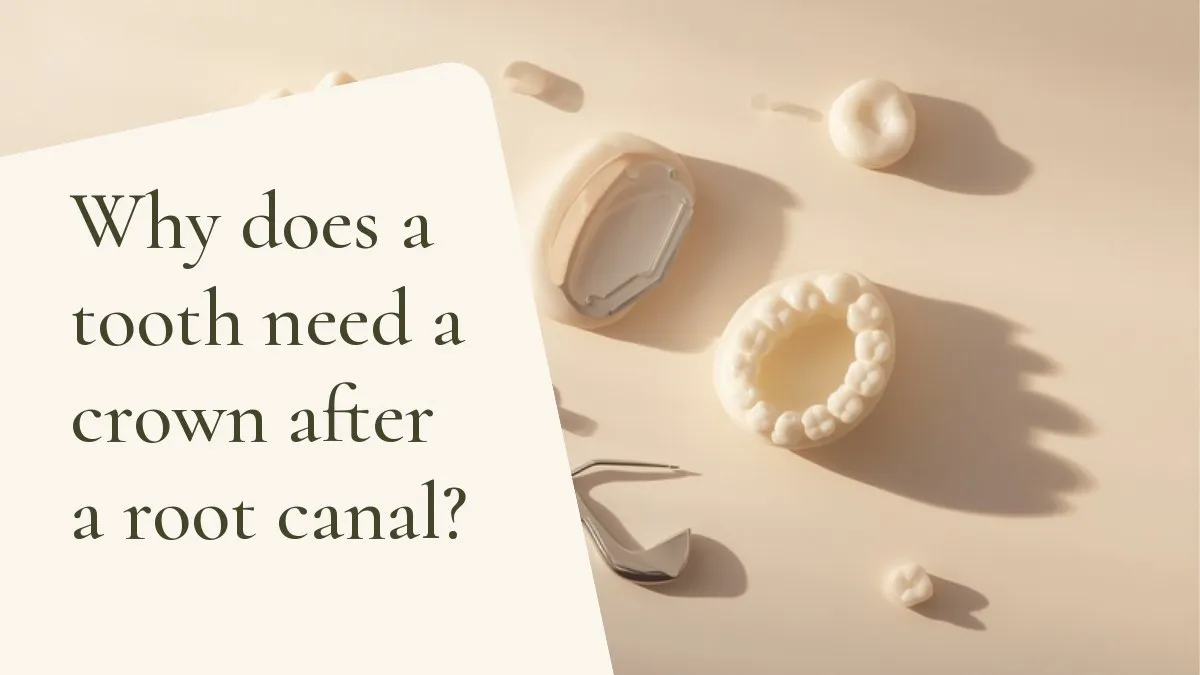
A crown is a "cap" that covers the tooth, hugging and protecting the remaining structure. It distributes biting force and greatly reduces the risk of fracture. On teeth that take heavy chewing force, like molars, it's usually even more important.
Not every treated tooth needs a crown. Front teeth with little loss of structure are sometimes well protected by a proper filling. Molars and badly damaged teeth, on the other hand, usually benefit from (or need) a crown. The dentist evaluates each case.
There are also root posts, used in some cases to support the rebuilding of a badly damaged tooth before the crown. Whether one is needed depends on how much structure is left — it's a technical decision made during planning.
In short, the crown (or reinforced restoration) isn't an "extra": it's what protects a tooth that has become fragile, so it can last. That's why restoring the tooth is an essential part of root canal treatment, not something optional for later.
| Tooth condition | Protection usually recommended |
|---|---|
| Front tooth with little loss of structure | A proper filling is sometimes enough to protect it well |
| Molar, which takes heavy chewing force | A crown is usually recommended |
| Tooth badly damaged by a large cavity, extensive filling or fracture | A crown is usually recommended |
| Tooth still with a temporary | Short-term protection: avoid chewing hard and hard foods on that side |
| The temporary broke or fell out | Have the dentist replace it promptly |
What happens without a crown, and when should you get one?
Without proper protection, the treated tooth is at risk of fracturing under chewing. A fracture can be irreparable, leading to the loss of the tooth — exactly what the root canal was meant to prevent. Putting off the crown is one of the main reasons people lose a tooth that has already been treated.
That's why the final restoration or crown shouldn't be delayed after the root canal. The tooth usually gets a temporary for a while, but a temporary doesn't have the strength of the final piece — it's short-term protection, not the solution.
The timing of the crown is decided by the dentist: generally after the root canal is finished and the tooth is confirmed to be stable. In some cases there's a short wait; in others, the final restoration follows right away.
While the tooth has only a temporary, take extra care: avoid chewing hard on that side and don't bite hard foods. If the temporary breaks or falls out, see the dentist to replace it promptly, to avoid contamination and fracture.
After the crown, care is the same as for a natural tooth: thorough hygiene (the part of the tooth under the crown can still get a cavity at the margin), flossing and check-ups. People with bruxism may need a night guard, because the overload also threatens the crown.
Finally, think of the crown as the stage that safely "closes" root canal treatment. Well done and well protected, a treated tooth can last many years. Investing in that protection is what makes all the effort of the root canal worth it in the long run.
Why does a tooth need a crown after a root canal?
+
Because removing the pulp and the damaged part leaves the tooth with less structure, more fragile and prone to fractures. The crown "hugs" the tooth, distributes biting force and protects it. It's what helps the treated tooth last instead of fracturing.
Does every tooth with a root canal need a crown?
+
Not necessarily. Front teeth with little loss of structure are sometimes well protected by a proper filling. Molars and badly damaged teeth usually need a crown. The dentist evaluates each case individually.
What happens if I don't get the crown?
+
The tooth is at risk of fracturing under chewing, which can be irreparable and lead to losing the tooth — exactly what the root canal was meant to prevent. Putting off the crown is one of the main reasons people lose a tooth that was already treated.
Why does a treated tooth become fragile?
+
Because it loses the pulp, part of its internal structure (from decay or fracture) and the hydration the pulp provided, becoming stiffer and more brittle. The more structure it has lost, the more fragile it is — and the greater the need for protection like a crown.
Can I put off the crown?
+
It's not advisable. A tooth with only a temporary is vulnerable to fracture and contamination. The final restoration or crown should be done within the recommended time. Delaying it means risking a tooth that has already gone through the whole root canal treatment.
What's the difference between a crown and a regular filling?
+
A regular filling replaces part of the tooth; a crown covers the whole tooth, hugging and protecting the remaining structure and distributing biting force. On badly weakened teeth, a crown protects against fractures more effectively than a simple filling.
What is the post in a root-canal-treated tooth?
+
It's a root post, used in some cases to support the rebuilding of a badly damaged tooth before the crown. Whether it's needed depends on how much structure is left. It's a technical decision made by the dentist during planning.
Does a treated molar always need a crown?
+
It usually benefits a lot, because molars take heavy chewing force and have often lost a good deal of structure. A crown reduces the risk of fracture in these teeth. The final recommendation, however, is evaluated case by case by the dentist.
When should I get the crown after a root canal?
+
Generally after the root canal is finished and the tooth is confirmed to be stable. In some cases there's a short wait; in others, the final restoration follows right away. The dentist sets the timing based on your case.
Does a temporary protect like a crown?
+
No. A temporary is short-term protection, without the strength of the final piece. It's there until the crown is ready. So while you only have the temporary, avoid chewing hard on that side and biting hard foods.
Can a tooth with a crown get a cavity?
+
The crown doesn't cause cavities, but the margin between the crown and the tooth, and the part of the tooth under it, can still decay if hygiene slips. That's why brushing and flossing remain essential to protect the crowned tooth.
Does a crown last forever?
+
It's durable when well made and well cared for, but it may need replacing over the years. Hygiene, habits (bruxism) and check-ups all play a part. Regular follow-up checks the crown and the health of the tooth and surrounding gums.
Does bruxism affect the treated tooth and the crown?
+
Yes. Grinding or clenching overloads the treated (already fragile) tooth and the crown, increasing the risk of fracture. People with bruxism usually need a night guard to preserve the tooth and the crown.
Is the crown worth the investment?
+
It usually is: the crown protects a tooth that, without it, is at risk of fracturing and being lost. Losing the tooth would require a replacement (implant or prosthesis), which is generally more complex. The crown is what makes root canal treatment last in the long run.
Where can I get a crown for a treated tooth in Mooca?
+
Dr. Cléo Salustiano (CRO-SP 170844) sees patients at Rua Hipódromo, 1141, in Mooca, São Paulo, Monday to Sunday, 8 a.m. to 10 p.m., in Portuguese, English and Spanish. The assessment determines whether the treated tooth needs a crown and how to protect it.