 Dra. Cléo Salustiano
In this article
SummaryWhat determines the cost of a tooth extraction?Should you extract the tooth or try to save it?FAQRead nextHow much does a tooth extraction cost? What determines the price

Quick summary of this article+
The cost of a tooth extraction depends on its complexity: the number and shape of the roots, whether the tooth is broken or impacted, infection, imaging, stitches and follow-up. Simple and surgical extractions are different procedures. Before extracting, find out whether the tooth can be saved and how the gap will be handled. The quote is defined after the assessment.
How much it costs to pull a tooth is one of the most common questions dental offices receive, and the honest answer is that it depends on the tooth and its condition. A simple extraction of a loose, single-rooted tooth is very different from removing an impacted, tilted wisdom tooth or a molar broken at the gumline with three curved roots. That is why the quote is defined after the assessment and, in most cases, an X-ray.
In clinical practice, it is common to meet patients who chose extraction because it seemed quicker and cheaper, without knowing the tooth could be saved. The opposite also happens: someone postpones removing a tooth that cannot be kept and ends up with an infection that makes the procedure more involved. Understanding what affects the price helps you compare quotes and decide calmly.
In this article, Dr. Cléo Salustiano (CRO-SP 170844), who sees patients in Mooca, East Zone of São Paulo, explains the types of extraction, what is included and what to consider before deciding to remove a tooth. In line with Brazilian dental advertising rules, this content does not list prices.
This article comes from Dr. Cléo Salustiano's dental office in Mooca, São Paulo (care in English, Portuguese and Spanish). See the general dentistry page to learn how the treatment is done here and book your assessment.
What determines the cost of a tooth extraction?
The cost of an extraction is defined mainly by its complexity: how many roots the tooth has and how they are positioned, whether the tooth is intact or broken, whether it is fully erupted or impacted in the bone, and whether there is an active infection. Imaging, stitches and follow-up care also count.
In a simple extraction, the tooth is visible, has enough crown to grip and roots that allow removal without cutting bone. In a surgical extraction, the gum must be opened, some bone removed or the tooth sectioned, as with impacted wisdom teeth, molars with spread roots and leftover root fragments. Root-canal-treated teeth tend to be brittle, and roots close to the sinus or the jaw nerve may require a CT scan and extra care.
What comes with the extraction also matters: X-rays, anesthesia, sutures, possible bone-preservation material when an implant is planned, a visit to remove stitches and written instructions. When comparing quotes, ask what each one includes. And think about what comes next: a missing front tooth affects appearance, and a missing molar may let neighboring teeth tip over time, so replacement is often part of the plan.
Should you extract the tooth or try to save it?
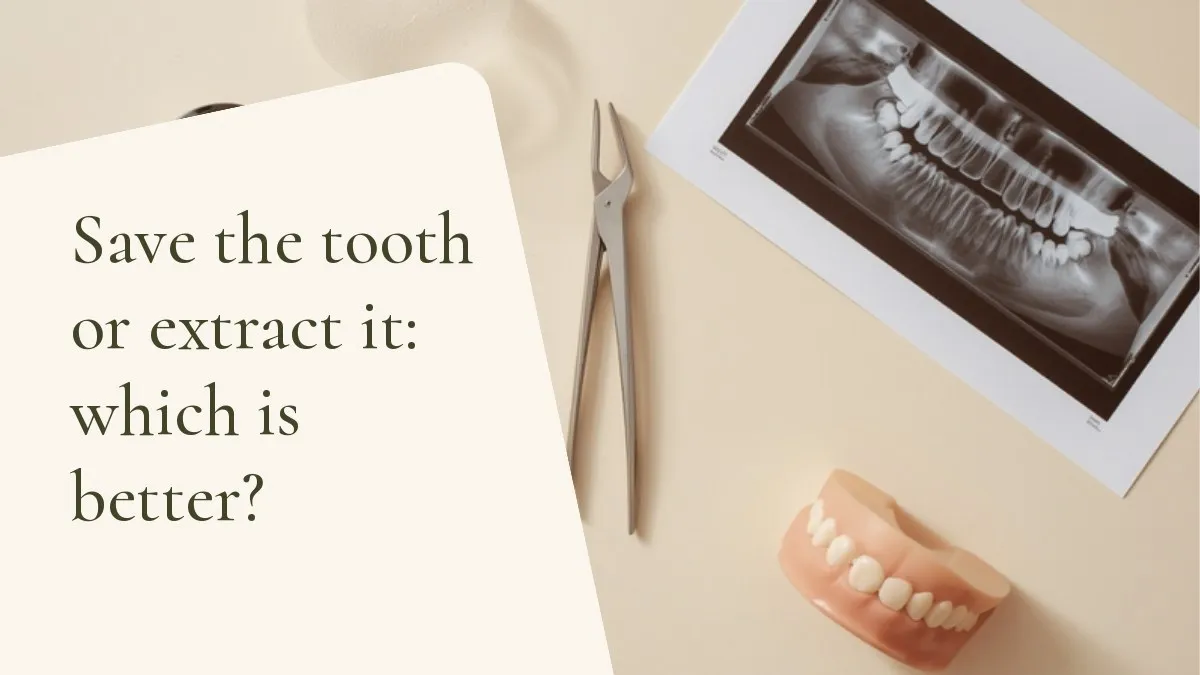
Saving the tooth is worthwhile whenever it has enough structure and bone support to keep working healthily, because no replacement is quite the same as a natural tooth. Extraction is indicated when the tooth is severely destroyed, has a root fracture or advanced bone loss, is a problematic wisdom tooth, or needs to come out for orthodontic reasons.
At the assessment, the dentist examines the tooth, takes an X-ray and explains the options. A deeply decayed tooth may be saved with a root canal and crown; a broken tooth may be rebuilt if the fracture does not extend below the bone. Comparing both paths helps you decide with information, not only by the immediate cost.
If extraction is the best choice, tell the dentist about all your medicines, especially blood thinners, and about conditions such as diabetes or high blood pressure. Afterwards, rest for the first 24 hours, eat cold and soft food and avoid straws and exercise. In Mooca, Dr. Cléo Salustiano sees patients every day, including Sundays and holidays, from 8 a.m. to 10 p.m., near Bresser-Mooca subway station, and explains the diagnosis, the options and a full quote before any procedure.
How much does it cost to pull a tooth?
+
It depends on the type of extraction. Removing a loose, single-rooted tooth is very different from removing an impacted wisdom tooth or a broken molar with curved roots. Imaging, stitches and follow-up also play a part. That is why the quote is given after the assessment and usually an X-ray, with everything included explained.
Why won't the dentist quote an extraction by message?
+
Without seeing the tooth and the X-ray, it is impossible to know whether the extraction will be simple or surgical, how many roots there are or whether there is infection. A blind quote may not match the real procedure. Brazilian dental advertising rules also advise against publishing prices without an assessment.
Is wisdom tooth removal more expensive?
+
Often yes, because wisdom teeth are frequently partly or fully impacted, tilted or close to the jaw nerve, which requires opening the gum, removing bone or sectioning the tooth. A wisdom tooth that erupted straight and is fully in the mouth, however, may be a simple extraction. The X-ray shows which case applies.
Is it better to pull the tooth or get a root canal?
+
When the tooth has enough structure and support, a root canal and restoration usually preserve function and appearance best, because no replacement equals a natural tooth. Extraction is indicated when the tooth cannot be kept healthy. The decision is made with an exam and an X-ray.
Does a tooth extraction hurt?
+
During the procedure, local anesthesia blocks pain; you may feel pressure and movement, but not pain. Once the anesthesia wears off, discomfort for two or three days is common and is managed with the medication your dentist recommends. Pain that increases after the third day should be checked.
What can replace an extracted tooth?
+
Options include a dental implant, a fixed bridge supported by neighboring teeth and a removable partial denture. The choice depends on the location, the amount of bone, the health of nearby teeth and your preference. For some back teeth, when chewing is not affected, not replacing may be an option after an assessment.
Where can I have a tooth extracted in Mooca, São Paulo?
+
In Mooca, Dr. Cléo Salustiano (CRO-SP 170844) sees patients at Rua Hipódromo, 1141, every day from 8 a.m. to 10 p.m., including Sundays and holidays, in Portuguese, English and Spanish. Before recommending an extraction, she checks whether the tooth can be saved and explains how to replace it, with a complete quote.