 Dra. Cléo Salustiano
 In this article
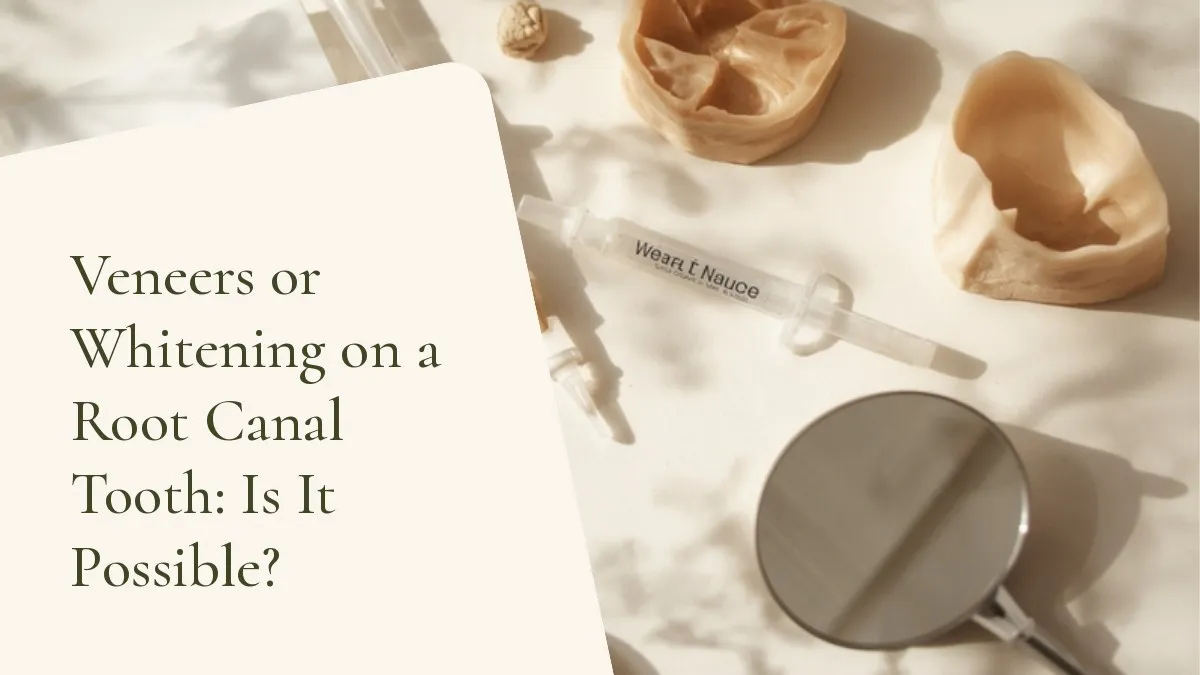
SummaryCan a root canal tooth be whitened or get a veneer?What should be checked before cosmetic work on a root canal tooth?FAQRead nextVeneers or Whitening on a Root Canal Tooth: Is It Possible?
Book your root canal treatment assessment on WhatsAppPrefer not to wait for a reply? Book online now, no phone call needed: see the open times and pick yours, any time (booking page in Portuguese).
Quick summary of this article+
A root canal tooth that has darkened can have its appearance restored. Since the darkening is internal, regular whitening usually does not solve it; the options are internal bleaching (from inside the tooth), veneers (composite or porcelain) or, for badly broken-down teeth, a crown (made in the desired shade). The choice depends on how dark the tooth is, its structure and the goal, always after confirming that the root canal is healthy. In Mooca, Dr. Cléo Salustiano (CRO-SP 170844) sees patients every day, from 8 a.m. to 10 p.m.
Can you get a veneer or whitening on a tooth that has had a root canal? Yes, in many cases, but with a few particularities. A root canal-treated tooth can darken over time, and there are specific ways to restore its color and appearance: internal bleaching (done from inside the tooth) and veneers. What fits your case depends on the condition of the tooth, as assessed by your dentist.
In clinical practice, patients are often bothered by a tooth that darkened after a root canal, usually a front tooth. The good news is that there is a cosmetic solution. Understanding the options helps you keep realistic expectations and choose the right path.
In this article, Dr. Cléo Salustiano (CRO-SP 170844) explains why root canal teeth darken, how internal bleaching works, when veneers come in and what to check. As always, the recommendation depends on an individual assessment. She sees patients in Portuguese, English and Spanish.
This article comes from Dr. Cléo Salustiano's dental office in Mooca, São Paulo (care in English, Portuguese and Spanish). See the root canal treatment page to learn how the treatment is done here and book your assessment.
Can a root canal tooth be whitened or get a veneer?
Yes, it is possible, but the approach is specific. A root canal-treated tooth can darken over time, because losing the pulp changes its color from the inside. This darkening is internal, so regular (external) whitening usually does not solve it, hence the specific techniques.
For a tooth darkened after a root canal, there is internal bleaching (also called non-vital tooth bleaching): the whitening agent is placed inside the tooth, in the space where the pulp used to be, and works from the inside out. It is different from whitening the outer surfaces of the other teeth.
When internal bleaching is not enough or not recommended, veneers (composite or porcelain) are a very good option: they cover the tooth, restoring color and shape in one go. They are widely used to blend a darkened tooth with the others.
There are also situations where the treated tooth needs a crown (because it is badly broken down), and the crown itself solves the cosmetic issue, since it is made in the desired shade. In other words, the cosmetic solution can be combined with the protection the tooth already needs.
The choice between internal bleaching, a veneer or a crown depends on how dark the tooth has become, how much structure it has left, whether it needs protection and the cosmetic goal. It is not a one-size-fits-all decision; it is assessed case by case, considering the health of the treated tooth.
Important: before any cosmetic procedure, the dentist confirms that the root canal treatment is sound and the tooth is healthy (no reinfection). Aesthetics start with health; you do not "dress up" a tooth with a problem underneath. The assessment confirms that foundation.
| Option | When it is usually recommended | Note |
|---|---|---|
| Regular (external) whitening | Does not solve root canal darkening on its own | The darkening is internal, caused by loss of the pulp |
| Internal bleaching | Milder darkening, in a tooth with good structure | The agent is placed inside the tooth, in the space where the pulp used to be |
| Composite or porcelain veneer | When internal bleaching is not enough or not recommended | Covers the tooth, restoring color and shape in one go |
| Crown | Badly broken-down tooth | Restores structure and is made in the desired shade |
| Before any option | Confirm the root canal is well treated and there are no signs of reinfection | Imaging helps with this check |
| About harmony | The goal is for the treated tooth to match its neighbors | Veneers and crowns do not whiten afterward — the shade is set when they are made |
What should be checked before cosmetic work on a root canal tooth?
The first step is confirming that the root canal is well treated and the tooth is healthy, with no signs of reinfection. Imaging helps with this. Doing cosmetic work on a tooth with a problem underneath would hide it, not solve it, which is why the assessment comes first.
Consider how dark the tooth is. Milder darkening may respond well to internal bleaching; more intense darkening, or a badly broken-down tooth, may call for a veneer or crown. The assessment determines the most suitable technique to reach the desired shade.
Assess the tooth's structure. If the treated tooth has good structure, internal bleaching or a veneer may be enough. If it is badly broken down, it usually needs a crown (which also solves the color). The amount of remaining tooth guides the choice.
Align expectations about harmony. The goal is for the treated tooth to match its neighbors. In some cases, the other natural teeth are whitened first, and then the treated tooth and any veneers are matched to that color. The sequence is planned.
Remember that veneers and crowns do not whiten afterward. That is why the shade is chosen during planning, in harmony with the smile. If you plan to whiten your other teeth, that is usually done before the final cosmetic work on the root canal tooth.
Finally, keep up with follow-up. A treated tooth, even one that looks good, needs checkups to monitor the health of the root canal and the restoration over time. Well cared for, it can last many years, looking good and working well.
Can a root canal tooth be whitened?
+
Yes, but with a specific technique. Since the darkening of a treated tooth is internal, regular whitening usually does not solve it. Internal bleaching, done from inside the tooth, is used instead. Whether it is suitable depends on the condition of the tooth, as assessed by your dentist.
Why does a root canal tooth darken?
+
Because losing the pulp (the "nerve") changes the tooth's color from the inside, making it grayer or more yellowish over time. It is internal darkening, different from external stains, which is why it needs specific whitening techniques.
What is internal bleaching?
+
It is whitening a root canal-treated tooth from the inside, placing the whitening agent in the space where the pulp used to be so it works from the inside out. It is different from whitening the outer surfaces of the other teeth.
Can a root canal tooth get a veneer?
+
Yes, in many cases. A veneer (composite or porcelain) covers the tooth, restoring color and shape, and is a very good option to blend a darkened tooth with the others, especially when internal bleaching is not enough or not recommended.
Internal bleaching or a veneer: which should I choose?
+
It depends on how dark the tooth is, its structure and your goal. Mild darkening may respond to internal bleaching; more intense cases or broken-down teeth may call for a veneer or crown. The assessment determines the right technique for your case.
Could a root canal tooth need a crown instead of a veneer?
+
Yes. If the tooth is badly broken down, it usually needs a crown (which protects it and also solves the cosmetic issue, made in the desired shade). In these cases, the cosmetic solution is combined with the protection the tooth already needs. The assessment decides.
Does anything need to be confirmed before cosmetic work?
+
Yes: that the root canal is well treated and the tooth is healthy, with no reinfection. Exams help with this. Doing cosmetic work on a tooth with a problem underneath would hide it, not solve it. Health always comes before aesthetics.
Does regular whitening work on a root canal tooth?
+
Usually not for internal darkening, because it acts on the outer surfaces. A treated tooth darkens from the inside, so the options are internal bleaching or veneers. The assessment identifies the type of darkening and the right technique.
Does a veneer on a root canal tooth last?
+
When well indicated and cared for, yes, like any veneer. It depends on hygiene, habits and checkups. On treated teeth, the foundation (the root canal and the tooth structure) needs to be healthy for the veneer to last. Follow-up helps preserve the result.
Can I whiten my other teeth and leave the root canal tooth as is?
+
You can, but the treated tooth may stand out. Usually the whole smile is planned: the natural teeth are whitened, and then the root canal tooth is matched (internal bleaching, veneer or crown) to the final shade. That way the smile looks even.
How many sessions does internal bleaching take?
+
It varies with how dark the tooth is and how it responds; it may take one or more applications. Your dentist monitors the color as it changes. Since every case responds differently, the number is decided during treatment, with no guaranteed shade.
Can a tooth whitened from the inside darken again?
+
In some cases, yes, over time. When that happens, there are options for a touch-up or moving to a veneer or crown. Follow-up makes it possible to assess and act. That is why maintenance and checkups matter for treated teeth too.
Do veneers and crowns get whiter with whitening later?
+
No. Veneers and crowns keep the color they were made in. That is why, if you plan to whiten your other teeth, it is usually done before the final cosmetic work on the root canal tooth, so the final shade is in harmony.
Where can I get cosmetic treatment for a root canal tooth in Mooca?
+
Dr. Cléo Salustiano (CRO-SP 170844) sees patients at Rua Hipódromo, 1141, in Mooca, São Paulo, Monday to Sunday, 8 a.m. to 10 p.m., in Portuguese, English and Spanish. The assessment confirms the tooth's health and determines the right technique: internal bleaching, a veneer or a crown.