 Dra. Cléo Salustiano
 In this article
SummaryWhat affects how long an implant crown lasts?What care keeps an implant crown in shape longer?FAQRead nextHow long does an implant crown last? Care to keep it in shape
Book your dental implants assessment on WhatsAppPrefer not to wait for a reply? Book online now, no phone call needed: see the open times and pick yours, any time (booking page in Portuguese).
Quick summary of this article+
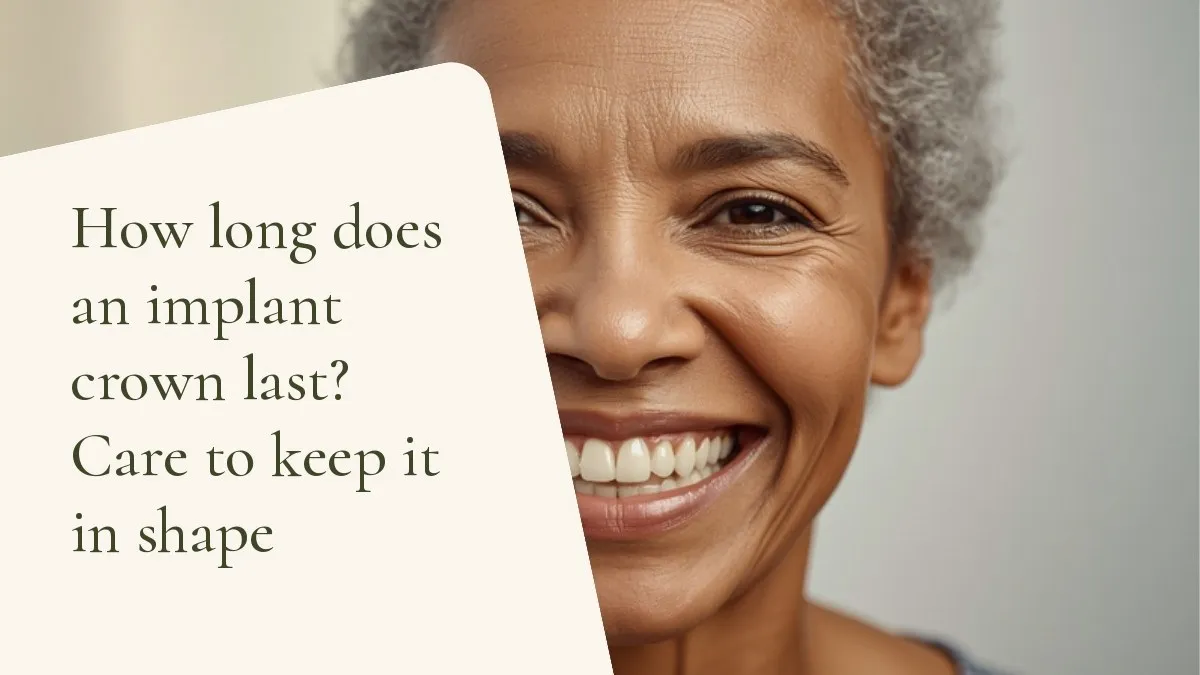
A well-cared-for implant crown usually lasts many years, often more than a decade, but with no guaranteed timeframe. Durability depends on planning, the material (porcelain or zirconia), the bite, habits and, above all, daily hygiene and regular checkups, which keep the gums and bone around the implant healthy. Signs such as a loose crown, bleeding or bad breath call for a visit before your scheduled checkup.
How long does an implant crown last? Well planned and well cared for, it usually lasts many years, often more than a decade, but there's no guaranteed timeframe: durability depends on the material, the bite, daily hygiene and regular checkups. The crown doesn't get cavities, but the gums and bone around the implant are still living tissue and need the same care as always.
It's a natural question for anyone who has invested time and effort in dental implant treatment: how long will the visible part of the new tooth last? In clinical practice, we see crowns in excellent condition after many years, and crowns with early problems, almost always linked to chewing overload, unprotected teeth grinding or inconsistent hygiene.
In this article, Dr. Cléo Salustiano (CRO-SP 170844), a dentist in Mooca, São Paulo, explains what affects the lifespan of an implant crown, which signs mean it's time to replace it and the care that makes a real difference in keeping it in good shape.
This article comes from Dr. Cléo Salustiano's dental office in Mooca, São Paulo (care in English, Portuguese and Spanish). See the dental implants page to learn how the treatment is done here and book your assessment.
What affects how long an implant crown lasts?
The first factor is planning plus execution. A crown with a good fit on the implant, an adjusted bite and a material suited to the tooth's position starts out with a long life expectancy. Poor adjustments concentrate force where it shouldn't be and shorten the life of any material, which is why the try-in and adjustment step is so important.
The second is the material. Porcelain and zirconia are stable and strong, each with its own profile: zirconia handles more load, which is an advantage for back teeth; porcelain offers better aesthetics for front teeth. In both cases, the material doesn't "rot" or get cavities; wear comes from the mechanics of chewing over the years.
The third, and perhaps the most decisive, is what happens around the crown. The gums and bone that support the implant can become inflamed (mucositis and peri-implantitis) when hygiene is neglected, and this is one of the main causes of long-term complications. A perfect crown on an inflamed implant is a treatment at risk.
The fourth is habits. Unprotected teeth grinding, biting nails or objects, chewing ice and using your teeth to open packages are sworn enemies of the crown, and of your natural teeth too. Small changes in habits, plus a night guard when recommended, significantly extend its lifespan.
Finally, there's professional maintenance. At checkups, the dentist checks screw tightness, the fit of the crown, the bite and gum health, and does a professional cleaning of the area. Problems caught early, like a loose screw or early inflammation, have simple solutions; if ignored, they can lead to replacing the crown or more complex treatment.
| Factor | How it affects it |
|---|---|
| Planning and execution | A good fit on the implant and an adjusted bite extend its life; poor adjustments concentrate force and shorten it |
| Material | Zirconia handles more load, which matters for back teeth; porcelain offers better aesthetics for front teeth |
| Cavities | Not applicable: wear comes from the mechanics of chewing over the years |
| Surrounding gums and bone | Mucositis and peri-implantitis are the biggest threat to the whole system |
| Daily hygiene | Brushing with soft bristles, attention to the gumline and cleaning between teeth |
| Bruxism | A night guard is one of the most cost-effective measures |
| Using teeth as tools | Shortens the life of any prosthesis |
| Warning signs | Crown that's loose or clicks when chewing, bleeding and redness in the surrounding gums |
What care keeps an implant crown in shape longer?
Thorough daily hygiene is the foundation: brushing at least twice a day with a soft brush, paying special attention to the gumline around the crown, and cleaning between teeth with floss, an interdental brush or a water flosser, as your dentist recommends for your case. The implant area deserves the same care as your natural teeth, or more.
Protect the crown from overload. If you grind or clench your teeth while sleeping, ask about a night guard; it's one of the most cost-effective ways to extend the life of crowns, veneers and your natural teeth. And avoid turning your teeth into tools: opening packages, chewing on objects and crunching ice shorten the life of any prosthesis.
Watch for warning signs: a crown that feels loose or "clicks" when you chew, bleeding gums around the implant, redness, persistent bad breath in the area, pain or a visible crack. None of these signs should wait for your next checkup. The sooner the cause is treated, the lower the chance of damaging the crown or the implant.
Diet also helps, without requiring a restrictive routine: cut very hard foods into smaller pieces, chew on both sides of your mouth to spread the force and go easy on very sticky foods that repeatedly pull on the crown. These are small adjustments that, over the years, significantly reduce the cumulative load on the crown.
Keep to the checkup schedule your dentist sets, even when everything seems fine. No pain doesn't mean no problem: implants have no nerve, and inflammation around them can progress silently. Periodic X-rays are how the supporting bone is monitored over the years.
And remember that replacing the crown, if it's ever needed, doesn't mean redoing the implant: in most cases, the crown is replaced on the same post, in a much simpler process than the original treatment. At Dr. Cléo's office in Mooca, follow-up is individual and checkups are scheduled according to your case, Monday to Sunday, 8 a.m. to 10 p.m., in Portuguese, English and Spanish.
How many years does an implant crown last?
+
There's no fixed or guaranteed timeframe, but well-planned, well-cared-for crowns often last more than ten years. Daily hygiene, regular checkups, an adjusted bite and protection against teeth grinding are the factors that matter most in reaching, and going beyond, that mark.
Does an implant crown need to be replaced from time to time?
+
Not as a rule. Replacement happens when there's a reason: a fracture, wear, poor fit, cosmetic issues or a problem with the surrounding gums. With up-to-date maintenance, many crowns keep working for long periods without needing replacement.
Does the implant last longer than the crown?
+
In general, yes. An implant integrated with the bone, with healthy gums, tends to stay in place for decades, while the crown, which takes the direct wear of chewing, may need maintenance or replacement sooner. Replacing the crown doesn't mean redoing the implant.
Can an implant crown get cavities?
+
No. Porcelain and zirconia don't develop cavities. However, the gums and bone around the implant can become inflamed (mucositis and peri-implantitis) if hygiene is neglected, and that inflammation is the main long-term threat to the treatment. Daily cleaning remains essential.
What shortens the life of an implant crown?
+
Teeth grinding without a night guard, a poorly adjusted bite, inconsistent hygiene, gum inflammation, chewing on objects, crunching ice and skipping checkups. Most of these factors are controllable, which is why daily care and professional follow-up make such a difference.
How do I know if my implant crown needs replacing?
+
Common signs: a visible crack or fracture, a crown that keeps coming loose, significant wear, a darkening margin along the gum or a poor fit identified during an exam. The decision is your dentist's, after a clinical exam and, when needed, an X-ray.
Is bleeding around an implant normal?
+
No. Bleeding when brushing or flossing around the implant suggests inflammation (mucositis) and calls for an assessment. Treated early, it usually reverses with professional cleaning and better hygiene; if ignored, it can progress to peri-implantitis, which damages the supporting bone.
Do I need a night guard even with a zirconia crown?
+
If you grind or clench your teeth, yes. The recommendation usually applies regardless of the material. Zirconia is stronger, but constant overload affects the screw, the implant, the bone and your other teeth. A night guard protects the whole system, not just the crown.
Can a professional cleaning damage the crown?
+
No, when done by a dentist with instruments suited to implant areas. On the contrary: regular professional cleaning removes the biofilm that brushing can't reach and is one of the main ways to prevent peri-implantitis.
Does teeth whitening lighten an implant crown?
+
No. Porcelain and zirconia don't change color with whitening. If you plan to whiten your natural teeth, ideally do it before the crown is made, so the crown's shade can be chosen to match your smile's new color.
How does an implant crown warranty work?
+
There's no universal warranty: each practice sets its own follow-up terms, and no dentist can promise durability for a set period, since biological response varies from person to person. What sustains longevity, in practice, is the combination of planning, daily hygiene and keeping up with regular checkups.
Does smoking shorten the life of an implant crown?
+
Smoking doesn't wear the crown directly, but it stains the surface and, more importantly, increases the risk of inflammation and bone loss around the implant, which can compromise the whole system. Quitting or cutting back protects both the implant and the crown.
Where can I get implant crown maintenance in Mooca?
+
Dr. Cléo Salustiano (CRO-SP 170844) provides follow-up and maintenance for implant crowns in Mooca, São Paulo, Monday to Sunday, 8 a.m. to 10 p.m., in Portuguese, English and Spanish. Book via WhatsApp (11) 97409-7834 or through Doctoralia.