 Dra. Cléo Salustiano
 In this article
SummaryWhat determines the cost of Invisalign?Invisalign, other aligners or braces: how to compare?FAQRead nextHow much does Invisalign cost? What determines the price

Quick summary of this article+
This article does not list prices: Brazil's Dental Code of Ethics does not allow prices to be advertised, and the cost of Invisalign is presented after the assessment, with the plan. What determines that cost is case complexity, the number of aligners, treatment time, refinements, the tools used during treatment, the exams and scan used in planning, the retainer at the end and any prior treatment, such as cavities or gum care. Invisalign, other aligners and braces should be compared by clinical indication, planning, follow-up and routine, not just by the total. Dr. Cléo Salustiano (CRO-SP 170844) sees patients in Mooca, São Paulo, Monday to Sunday, 8 a.m. to 10 p.m., in English, Portuguese and Spanish, with Invisalign and other aligners.
The cost of Invisalign is not fixed: it depends mainly on case complexity, the number of aligners planned, treatment time, refinements, the retainer at the end, and the exams and scans used in planning. That is why no one can say what it costs before an assessment. You will not find prices here: Brazil's Dental Code of Ethics does not allow dental offices to advertise prices, and the cost is presented after the assessment, together with the plan.
What can be explained, and what actually helps you decide, is what goes into that cost. Two Invisalign treatments can be very different: one fixes mild crowding in the front teeth, the other reorganizes the entire bite. Calling both by the same name does not make them the same work.
In this article, Dr. Cléo Salustiano (CRO-SP 170844) explains each factor that weighs on Invisalign treatment and how it compares, in factors rather than price, with other aligners and with traditional braces. If you would like to understand how the treatment works first, see how Invisalign works.
This article comes from Dr. Cléo Salustiano's dental office in Mooca, São Paulo (care in English, Portuguese and Spanish). See the braces and clear aligners page to learn how the treatment is done here and book your assessment.
What determines the cost of Invisalign?
The cost of Invisalign is set by how much work the case requires: how far the teeth need to move, how many aligners that takes, for how long, how many course corrections will be needed and what comes afterward. The first factor is complexity. A small gap or a slightly rotated tooth is very different from a crossbite, an open bite or severe crowding, and more complex cases require more steps and more follow-up.
The second factor is the number of aligners, which follows complexity. Each aligner moves the teeth a little, and the full sequence is planned in software before treatment starts. The manufacturer itself offers treatment tiers based on the number of aligners planned, so a short case and a broad case fall into different categories. Treatment time follows the same logic: more movement means more months of wear and more follow-up visits.
The third factor is refinements. Teeth do not always move exactly as planned, and it is common to need a new series of aligners midway or at the end to adjust what is left. It is worth knowing whether the plan includes refinements and under what conditions. This also covers the small tools used during treatment, such as attachments, small resin bumps bonded to the teeth to help the aligners grip, interproximal reduction, when small spaces need to be created, and elastics in some cases.
The fourth factor is planning and the end of treatment. At the start, there is a digital scan of the mouth, photos, X-rays and, depending on the case, other exams. At the end comes the retainer, fixed, removable or both, which holds the teeth in their new position. Without a retainer, teeth tend to shift back, which is why it is part of the plan and not an add-on. Learn more about retainers after orthodontic treatment.
Finally, there is the condition of your mouth before starting. Cavities, inflamed gums or tartar are treated before alignment begins, because moving teeth on an unhealthy foundation is not safe. These items usually appear as separate steps in the plan. They do not rule out treatment: they are the step that comes first.
| Factor | Invisalign | Other aligners | Braces |
|---|---|---|---|
| How it works | Clear trays changed in sequence, with the brand's own digital planning | Same principle, with each system's software and material | Brackets and wires adjusted at visits |
| Visibility | Nearly invisible | Nearly invisible | Visible (tooth-colored options exist) |
| Depends on patient wear | Yes, 20 to 22 hours a day | Yes, 20 to 22 hours a day | No, fixed to the teeth |
| Hygiene and eating | Removed to eat and brush | Removed to eat and brush | Requires more care with hygiene and food |
| Refinements | Common; rules vary by tier | Common; rules vary by system | Adjustments made at visits |
| Retainer at the end | Needed | Needed | Needed |
| Indication | Set at the assessment, based on complexity | Set at the assessment, based on complexity | Set at the assessment, based on complexity |
Invisalign, other aligners or braces: how to compare?
Invisalign, other aligners and braces should be compared by factors such as clinical indication, planning, follow-up, daily routine and upkeep, not just by the final cost. All three move teeth; what changes is how they do it, which cases they suit and what they require from the patient. In orthodontics, the choice is clinical before it is financial.
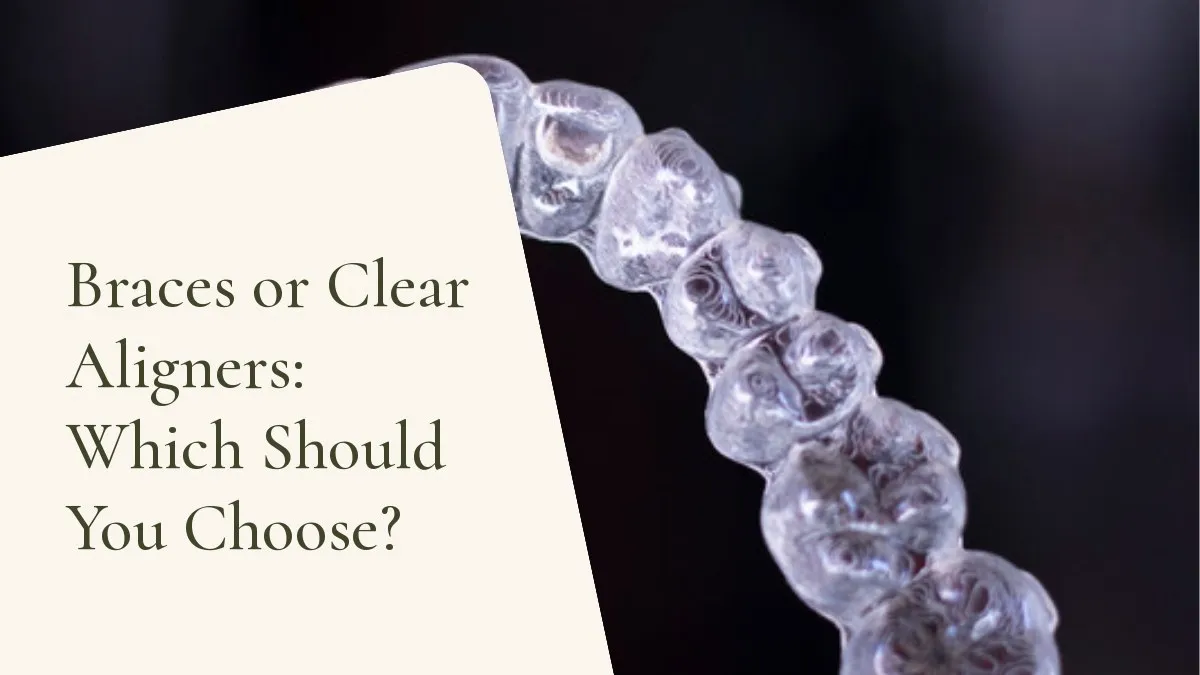
Invisalign is an aligner brand with its own digital planning system and materials, and it has a long track record in treating cases of different complexity. Other aligners, from other brands or systems, follow the same principle of clear trays changed in sequence, with differences in software, material, available tiers and refinement rules. The office works with Invisalign and with other aligners, and the choice between them depends on the case and on what each system offers for that need.
Braces remain a versatile option for many types of tooth movement and do not depend on the patient remembering to wear them. On the other hand, they are visible, require more care with hygiene and food, and need adjustment visits. Aligners are nearly invisible and removable, which makes brushing and eating easier, but they only work if worn most of the day, usually 20 to 22 hours, every day.
When you receive a plan, ask: how many aligners are planned, whether refinements are included and under what conditions, which exams and scans are covered, whether the retainer is in the plan and what kind, how often follow-up visits will be and what is not included, such as prior treatment. Two plans with the same name can contain very different things.
And understand why the cost only comes after the assessment: the exam is what shows complexity, the number of aligners, the likely duration and the steps before and after. Without it, any number would be a guess about a mouth no one has seen. The assessment at the office takes about 30 minutes, and the plan is presented before any decision.
How much does Invisalign cost?
+
Prices cannot be listed here: Brazil's Dental Code of Ethics does not allow dental offices to advertise them. The cost depends on case complexity, the number of aligners, time, refinements and the retainer, and it is presented after the assessment, with the plan.
Why does the cost of Invisalign vary so much from case to case?
+
Because mild crowding in the front teeth and a full bite correction are very different jobs. The number of aligners, the time, the refinements and the follow-up all change.
What are Invisalign refinements?
+
They are new series of aligners made when the teeth do not move exactly as planned. They are common and part of treatment. It is worth asking whether the plan includes refinements and under what conditions.
Is the retainer included in treatment?
+
It depends on the plan, so it is worth checking. The retainer is what keeps the teeth in their new position; without it, teeth tend to shift back. That is why it is part of treatment, not an add-on.
Invisalign or another aligner: which should I choose?
+
Both follow the same principle of clear trays in sequence, with differences in software, material and tiers. The office works with both, and the choice depends on your case and on what each system offers for it.
Aligners or braces?
+
It depends on the case and your routine. Braces do not depend on you remembering to wear them and are versatile for many movements. Aligners are discreet and removable, but must be worn 20 to 22 hours a day to work.
Do I need to treat cavities or gums before Invisalign?
+
Yes, if there are any. Moving teeth on an unhealthy foundation is not safe, so those steps come first. They do not rule out treatment: they are the step before it, and they appear separately in the plan.
Where can I get an Invisalign assessment in Mooca?
+
Dr. Cléo Salustiano (CRO-SP 170844) sees patients at Rua Hipódromo, 1141, in Mooca, near Bresser-Mooca station (Metro Line 3-Red), Monday to Sunday, 8 a.m. to 10 p.m., in English, Portuguese and Spanish. The assessment takes about 30 minutes; care is private, with no dental insurance plans.