 Dra. Cléo Salustiano
 In this article
SummaryStep by stepHow each system works: it's all in how the wire is tiedWhat the scientific evidence shows (and what really changes in practice)FAQRead nextTraditional or Self-Ligating Braces: What's the Difference?
Book your braces and clear aligners assessment on WhatsAppPrefer not to wait for a reply? Book online now, no phone call needed: see the open times and pick yours, any time (booking page in Portuguese).
Quick summary of this article+
The real difference between traditional and self-ligating braces is how the wire is held in the bracket: with traditional braces, by a ligature (the "rubber band") or metal tie; with self-ligating braces, by a clip built into the bracket. That's the source of the proven advantages of self-ligating braces: less plaque buildup (no elastic tie to collect plaque and turn yellow) and lower wire friction. Claims of faster treatment, less pain and fewer appointments don't hold up: systematic reviews found no significant difference between the systems on those points. In practice, the result depends far more on the orthodontist's diagnosis and planning than on the type of bracket.
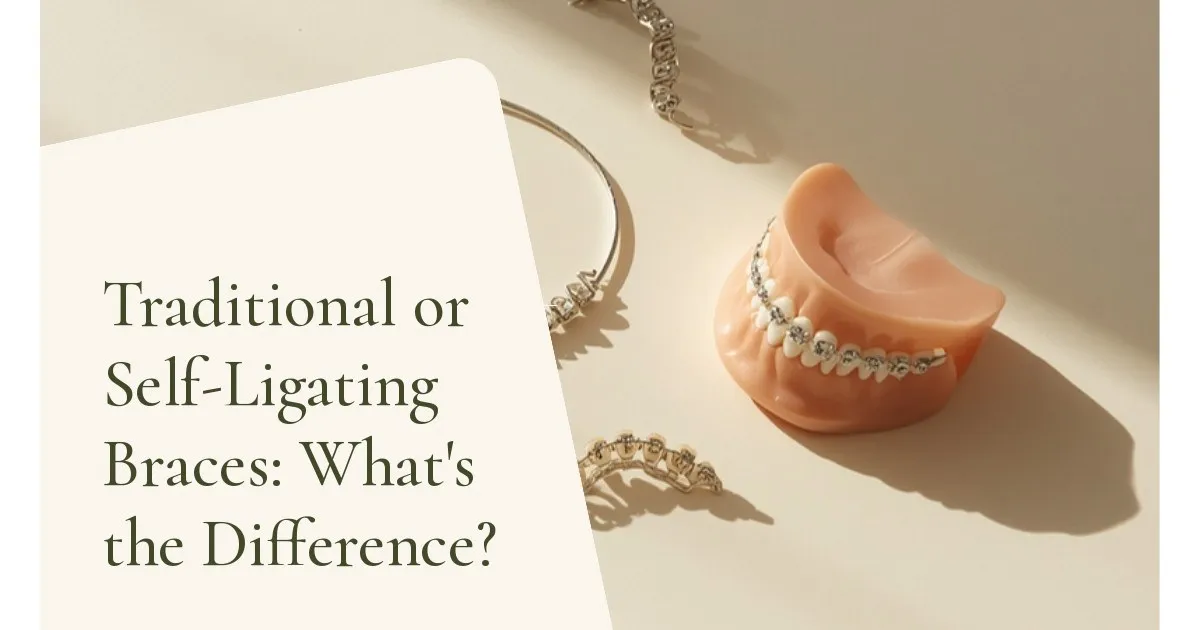
When you research fixed braces, you'll run into two names: traditional and self-ligating. The real difference between them is mechanical and comes down to a single detail — how the wire is held in the bracket. That detail is the source of each system's genuine advantages, and it's also where marketing often goes beyond what science supports.
Here you'll find how each system works, a side-by-side comparison table, what the scientific evidence shows about treatment time, pain and number of appointments, and a step-by-step guide to deciding together with your orthodontist.
This content is for information only and follows the rules of the Federal Council of Dentistry (CFO) and CRO-SP: no promised results and no advertised prices. The right choice always depends on an individual assessment. Dr. Cléo Salustiano (CRO-SP 170844) sees patients at Rua Hipódromo, 1141, in Mooca, São Paulo.
This article comes from Dr. Cléo Salustiano's dental office in Mooca, São Paulo (care in English, Portuguese and Spanish). See the braces and clear aligners page to learn how the treatment is done here and book your assessment.
Step by step
- Start with the diagnosis, not the bracket. Orthodontic records (X-rays, photos and models or a scan) define which movements your teeth need. Only after that diagnosis does it make sense to discuss which bracket system to use.
- Ask which system the orthodontist is most experienced with. The orthodontist's experience and technical command of a given system matter more to the result than the brand or type of bracket. Good treatment with traditional brackets beats poorly planned treatment with self-ligating ones.
- Think about your hygiene routine. If you struggle to keep up with brushing or tend to build up plaque, having no elastic tie with self-ligating braces is a real practical advantage — one less plaque-trapping surface around each bracket.
- Match your expectations to the evidence. Be wary of promises of treatment that's "much faster," "painless" or "with half the appointments" based only on the type of bracket. Scientific reviews don't support these claims — and the Brazilian Dental Code of Ethics prohibits promising results.
- Weigh the cost-benefit in your case. Self-ligating braces usually cost more. Ask for a written treatment plan with the planned stages, how often you'll come back and what's included, and compare calmly before deciding.
How each system works: it's all in how the wire is tied
With traditional braces, the orthodontic wire is held to each bracket by a ligature — an elastic ring (the familiar little "rubber bands," which can be colored or clear) or a thin metal tie. This ligature keeps the wire seated and lets it transmit the force that moves the teeth. The elastic ties are replaced at each adjustment appointment.
With self-ligating braces, the bracket has a built-in metal clip or door that closes over the wire. There are no elastic ties. There are two types: passive self-ligating, where the clip simply holds the wire in place loosely — which reduces friction; and active self-ligating, where the clip presses the wire against the base of the slot, giving more control over movement.
That's the structural difference between the two — and it's where the practical advantages of self-ligating braces that actually hold up come from: without the elastic tie, there's less plaque-trapping surface around the bracket, and there's no tie to turn yellow from coffee, tomato sauce or smoking between appointments. The wire also slides with less friction inside the bracket.
| Criterion | Traditional braces | Self-ligating braces |
|---|---|---|
| How the wire is held | By an elastic tie ("rubber band") or a metal tie | By a clip/door built into the bracket, with no elastic tie |
| Wire friction | Higher, because of the tie | Lower — the wire slides more freely in the slot |
| Cleaning | The elastic tie is one more surface that traps plaque | No tie: less plaque buildup around the bracket |
| Staining | Clear ties tend to turn yellow between appointments | No tie to stain |
| At the adjustment appointment | Ties are replaced at every visit | The clip is simply opened and closed; no ties to replace |
| Discomfort in the first few days | Expected after adjustment | Also happens — studies show no significant difference between systems |
| Number of appointments | Regular follow-ups set by the orthodontist | Systematic reviews found no significant reduction in the number of appointments |
| Total treatment time | Depends on diagnosis and planning | Systematic reviews found no significant reduction in total time |
| Tooth-colored versions | Available (ceramic/polycarbonate), but clear ties can stain | Available (ceramic/polycarbonate), with no tie to stain |
| Cost | Generally lower | Generally higher (varies by case and office) |
| Suitability | Works for most orthodontic cases | Works for most orthodontic cases |
What the scientific evidence shows (and what really changes in practice)
You'll often hear that self-ligating braces are "faster," "hurt less" and "need fewer appointments." Systematic reviews comparing the two systems found no statistically significant difference in initial pain, number of appointments or total treatment time. A review with network meta-analysis comparing traditional, passive self-ligating and active self-ligating brackets concluded that the vast majority of variables studied showed no significant difference among the three types.
That doesn't make self-ligating braces a bad choice — it just shows that bracket type isn't what determines treatment success. What really matters is the diagnosis, planning and case management by the orthodontist, together with patient cooperation: wearing elastics when prescribed, thorough hygiene and keeping follow-up appointments.
The advantages of self-ligating braces that hold up are mechanical and hygiene-related: without the elastic tie, there's less plaque buildup around the bracket and nothing to turn yellow between appointments; and lower friction allows lighter forces. On the other hand, traditional braces remain an established option that usually costs less — and colorful ties are often a plus for children and teens. If you're wondering whether the difference in cost pays off, see whether self-ligating braces are worth it in your case.
Whichever system you choose, the care is the same: brush after every meal with an orthodontic toothbrush, floss with a floss threader, watch out for hard and sticky foods (which knock off brackets) and keep your adjustment appointments. If a bracket comes loose or the end of a wire pokes you, contact your orthodontist rather than trying to fix it yourself.
What's the difference between traditional and self-ligating braces?
+
With traditional braces, the wire is held to the bracket by an elastic tie (the "rubber band") or a metal tie. With self-ligating braces, the bracket itself has a clip or door that closes over the wire, with no elastic tie at all. That's the structural difference between the two systems.
Are self-ligating braces faster?
+
There's no scientific proof of that. Systematic reviews comparing the two systems found no statistically significant difference in total treatment time. How long treatment takes depends on the diagnosis, the complexity of the case and the orthodontist's planning.
Do self-ligating braces hurt less?
+
Studies comparing initial pain between self-ligating and traditional braces found no significant difference. Some discomfort in the first few days after an adjustment is expected with both systems and tends to ease over the following days.
Do self-ligating braces need fewer appointments?
+
Scientific reviews found no significant difference in the number of appointments between the two systems. The interval between follow-ups is set by the orthodontist based on the stage of treatment and each patient's response.
Which one is easier to clean?
+
Self-ligating braces, because they have no elastic tie — which is exactly the part that traps the most plaque and turns yellow over time. Even so, cleaning with braces requires an orthodontic toothbrush and floss threader in both cases.
Are self-ligating braces more expensive?
+
Generally, yes: self-ligating brackets usually cost more than traditional ones. The price varies by case and office, and it should be presented in the treatment plan before you start, along with the planned stages and follow-ups.
Do self-ligating braces work for any case?
+
Both systems work for most orthodontic cases. The choice depends on the diagnosis, the movements needed and the orthodontist's planning — which is why the decision should come after the assessment, not before.
Are there tooth-colored self-ligating braces?
+
Yes. There are tooth-colored versions (ceramic or polycarbonate) of both traditional and self-ligating brackets. With traditional tooth-colored brackets, one caution: the clear ties tend to turn yellow between appointments.
Are self-ligating brackets and self-ligating braces the same thing?
+
The terms are used interchangeably: "bracket" is the technical name for each piece bonded to a tooth, and "braces" refers to the whole appliance. Self-ligating braces are built with self-ligating brackets — the same system, just named two ways. The same goes for "traditional brackets" and "traditional braces."
Which type of braces is more discreet?
+
Both types come in tooth-colored versions, with clear or tooth-colored brackets. For people who want the most discretion possible, clear aligners are usually the alternative, when the case allows. The assessment shows which options work for you.
Does the type of braces change the final result?
+
The result depends mainly on the orthodontist's diagnosis, planning and follow-up, plus the patient's cooperation. Traditional and self-ligating braces, when properly indicated, achieve similar results; the difference lies more in the day-to-day of treatment.
Do I need a retainer after self-ligating braces?
+
Yes. After any braces, teeth tend to shift back, and a retainer — fixed or removable — is what keeps them aligned. How long to wear it is set by your orthodontist and is usually long term.
Where can I get an orthodontic assessment in Mooca?
+
Dr. Cléo Salustiano (CRO-SP 170844) sees patients at Rua Hipódromo, 1141, in Mooca, São Paulo, Monday to Sunday, 8 a.m. to 10 p.m., in Portuguese, English or Spanish. Message the office on WhatsApp to book your assessment and find out which system — traditional or self-ligating — is more suitable for your case.