 Dra. Cléo Salustiano
 In this article
SummaryWhat's the difference between braces and clear aligners?How to choose between braces and clear alignersFAQRead nextBraces or Clear Aligners: Which Should You Choose?
Book your braces and clear aligners assessment on WhatsAppPrefer not to wait for a reply? Book online now, no phone call needed: see the open times and pick yours, any time (booking page in Portuguese).
Quick summary of this article+
Braces and clear aligners correct the position of the teeth in different ways. Braces have bonded brackets, work around the clock and don't depend on discipline, but they're more visible and require careful cleaning. Aligners are discreet, removable and make cleaning easier, but they only work with disciplined wear, and not every case can be solved with them. The choice depends on complexity and your routine, and is made at an assessment. In Mooca, Dr. Cléo Salustiano (CRO-SP 170844) sees patients every day from 8 a.m. to 10 p.m.
Braces or clear aligners: which should you choose? Both correct the position of the teeth, but in different ways — braces use brackets bonded to the teeth, and aligners are a series of removable transparent trays. The right option depends on your case, how complex the correction is and your routine, and only an orthodontic assessment can determine that safely. If you're deciding between the two types of brackets for fixed braces, see traditional or self-ligating braces: what's the difference?.
In practice, patients often arrive set on aligners because of how they look, without knowing that not every case can be solved with them, or that braces may be more suitable in certain situations. Understanding the differences helps set realistic expectations and make the decision together with your dentist.
Here, Dr. Cléo Salustiano (CRO-SP 170844) explains the differences between braces and aligners, their advantages, limits and care. Keep in mind that the recommendation is always individual and depends on an in-person assessment, often with exams.
This article comes from Dr. Cléo Salustiano's dental office in Mooca, São Paulo (care in English, Portuguese and Spanish). See the braces and clear aligners page to learn how the treatment is done here and book your assessment.
What's the difference between braces and clear aligners?
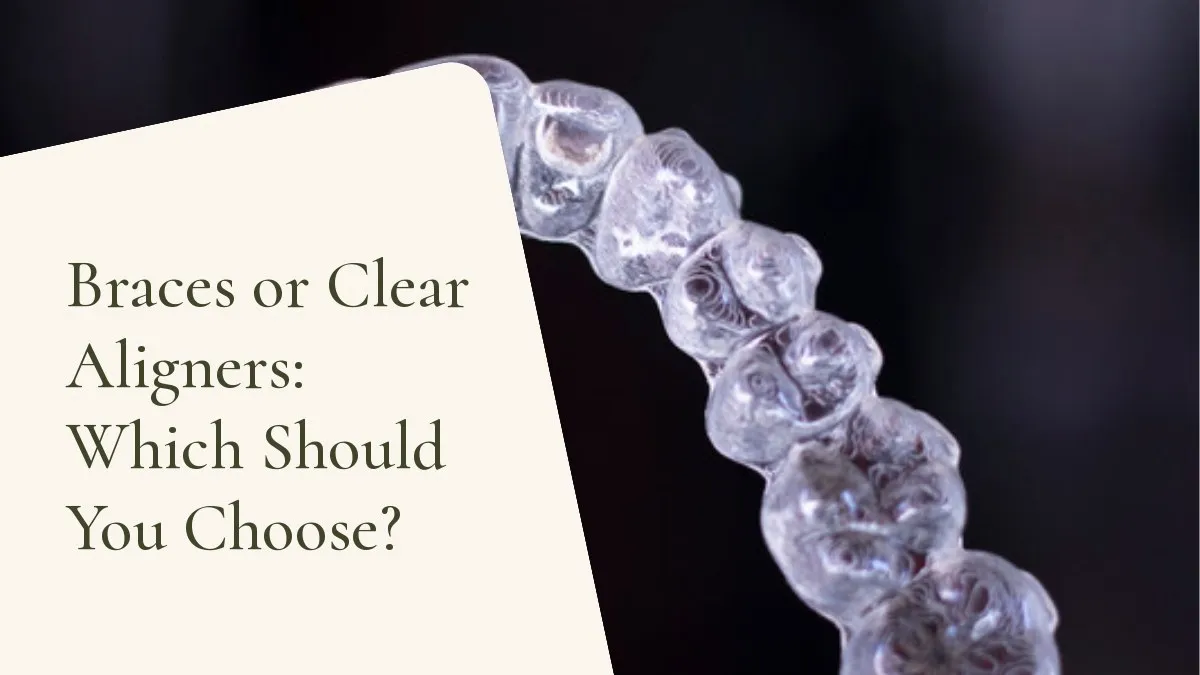
Fixed braces consist of brackets bonded to the teeth and wires that, with periodic adjustments, move the teeth to the planned position. Clear aligners are a set of transparent trays, switched in stages, that move the teeth gradually. Both have the same goal: aligning the smile and improving the bite.
The most visible difference is appearance: aligners are discreet and almost unnoticeable, while braces are more visible (although more discreet versions exist). For many people this matters — but it's only one of the factors to consider, not the only one.
Another important difference is that aligners are removable: you take them out to eat and brush, which makes cleaning easier. Braces, being bonded, require more careful cleaning around the brackets. On the other hand, braces don't depend on your discipline to work.
And here's a key point: aligners only work if they're worn for the recommended time each day (usually many hours). If the person doesn't have the discipline to wear them, treatment doesn't progress. Braces, being in the mouth all the time, work around the clock, regardless of your routine.
As for complexity, simple to moderate cases usually have good options with both braces and aligners; more complex corrections may call for a more specific approach. It's not that one is "better" than the other — each case responds better to one approach.
In Mooca and São Paulo's East Zone, both options are common. The logic for choosing is the same as in all orthodontics: it starts with a careful diagnosis and an individual plan made together with you, considering your goals, routine and oral health.
| Braces | Clear aligners | |
|---|---|---|
| How they work | Brackets bonded to the teeth and wires, with periodic adjustments | Transparent trays switched in stages |
| Appearance | More visible, though more discreet versions exist | Discreet, almost unnoticeable |
| Removed to eat and brush | No — they're bonded | Yes |
| Cleaning | Requires careful cleaning around the brackets | Easier, because the tray comes out |
| Depends on discipline | No — works around the clock | Yes — only works if worn for the recommended time |
| Before starting | Treat cavities and care for the gums | Treat cavities and care for the gums |
| After treatment | Retainer | Retainer |
How to choose between braces and clear aligners
The choice starts with an orthodontic assessment, usually with exams and sometimes digital planning. This shows how complex your case is and which options are viable, with the advantages and limits of each — you can't decide based on looks alone or on what worked for someone else.
Before starting any orthodontic treatment, it's essential to take care of the foundation: treat cavities and look after gum health. Moving teeth in an inflamed mouth or one with cavities increases risks. That's why orthodontics usually begins once your oral health is in order.
Consider your routine and discipline. If you tend to forget things or don't want to worry about putting trays in and taking them out, braces may be more practical. If you value discretion and have the discipline to wear aligners for the recommended time, they can be a good choice.
Think about hygiene, too. With braces, you need to clean carefully around the brackets, with a suitable toothbrush and often an interdental brush. With aligners, cleaning is easier, but you need to clean the trays and brush before putting them back, so you don't trap debris against your teeth.
Maintenance differs: braces need periodic adjustments at the office; aligners need tray changes and follow-up. At the end, both need a retainer to maintain the result — because teeth tend to try to return to their old position without this step.
Finally, always check the dentist's registration with the Regional Council of Dentistry (CRO). Orthodontics is diagnosis, planning and follow-up over time — and choosing someone with proper training and technical responsibility is what supports a safe result, whether with braces or aligners.
On the orthodontic treatment in Mooca page, you'll find the step-by-step process and other articles on the topic.
Braces or aligners: which is better?
+
There's no universal answer. Braces work around the clock and don't depend on discipline; aligners are discreet, removable and make cleaning easier, but they need to be worn many hours a day. The right option depends on the complexity of the case and your routine, and is determined at an assessment.
Do aligners work for every case?
+
Not always. Simple to moderate cases usually have good options with aligners; more complex corrections may call for a more specific approach. Only an orthodontic assessment, often with exams, can determine whether aligners can handle your case.
Are braces very noticeable?
+
Traditional braces are more visible, but there are more discreet versions, such as tooth-colored brackets. For people who prioritize discretion, aligners are almost unnoticeable. Appearance is an important factor, but not the only one in choosing treatment.
Do aligners hurt?
+
You may feel mild discomfort or pressure in the first few days of each new tray, a sign that the teeth are moving. It's temporary and usually well tolerated. Braces can also be sore after adjustments. Your dentist will advise on how to ease it.
Can I eat normally with aligners?
+
Yes, and that's an advantage: you remove the aligners to eat, so there are no food restrictions like with braces. But you need to brush before putting them back and wear the trays for the recommended time between meals.
Which one is easier to keep clean?
+
Aligners, because you remove them to brush and floss normally. Braces require more careful cleaning around the brackets, with specific brushes. With both, good hygiene is essential to avoid stains and gum problems.
How long does treatment take?
+
It varies with the complexity of the case and how well you stick to treatment, and can range from months to a few years. Aligners depend on disciplined wear to stay on schedule. An estimate is made during planning, with no guaranteed exact timeline.
Do aligners work if I forget to wear them?
+
Not as they should. Aligners only move teeth if worn for the recommended number of hours a day. If discipline is a problem, braces may be more suitable, since they work around the clock without depending on you to remember.
Do I need a retainer afterward?
+
Yes, in both cases. At the end of treatment, teeth tend to try to return to their old position. A retainer (fixed or removable) is what maintains the result. Skipping this step is one of the main reasons teeth get crooked again.
Do braces get in the way of whitening or veneers?
+
The order matters: normally the teeth are aligned first, and whitening or veneers come afterward, with the teeth in their final position. Doing cosmetic work before moving the teeth can compromise the result. Planning defines the right sequence for your case.
Can adults get braces?
+
Yes. Orthodontics has no age limit: what matters is the health of the teeth and gums. Many adults undergo treatment, and aligners are a popular option because they're discreet. The assessment determines the right approach for your case.
Can I see in advance how it will look?
+
In many cases, planning (including digital planning, with aligners) helps visualize the expected progress. It's a planning estimate, not a promised result — everyone responds differently, and adjustments along the way are normal.
Do braces stain teeth?
+
Braces themselves don't stain, but poor cleaning around the brackets can leave marks on the enamel. That's why thorough cleaning during treatment is so important. With aligners, the care is to clean the trays and brush before putting them back.
Do both need adjustments at the office?
+
Yes, in different ways. Braces need periodic wire adjustments; aligners need tray changes and progress checks. With both, follow-up appointments are essential for treatment to move forward safely.
Are clear aligners the same as Invisalign?
+
Invisalign is a brand of clear aligners, one of the best-known on the market — and one of the options Dr. Cléo Salustiano works with. "Clear aligners" is the generic term for this type of treatment with removable transparent trays, which comes in different brands. To learn more about the Invisalign system specifically, see the article Invisalign in Mooca.
Where can I get orthodontic treatment in Mooca?
+
Dr. Cléo Salustiano (CRO-SP 170844) sees patients at Rua Hipódromo, 1141, in Mooca, São Paulo, Monday to Sunday, 8 a.m. to 10 p.m., in Portuguese, English or Spanish. The assessment determines whether braces, aligners or another approach is most suitable for your case.